Smoking: Myth vs. Truth
A character-driven, scenario-based e-learning module that empowers college students to critically examine the psychological and social forces behind smoking — through story, reflection, and guided conversation rather than fear-based messaging.
The Learning Challenge
Fear-based programs fail young adults
Most smoking awareness programs rely on long-term health statistics and fear-based warnings. While scientifically accurate, this approach largely fails to resonate with young adults — because it doesn't address why they start smoking in the first place.
Reframe around psychology, not fear
By reframing the content around psychological motivations rather than physical consequences, the module meets learners where they are emotionally and socially — without moralizing, preaching, or triggering defensiveness.
College students navigating identity
Students navigating academic pressure, peer dynamics, identity formation, and new social environments. Many encounter smoking for the first time — or are already occasional smokers — making this a critical intervention window.
Relatable. Honest. Emotionally intelligent.
Learners should leave the module questioning their assumptions about smoking — not feeling lectured. The experience needed to feel relatable, honest, and emotionally intelligent rather than institutional or clinical.
Instructional Approach
Scenario-Based Learning
Learners observe and engage with a realistic student narrative rather than consuming static information slides.
Behavioral Psychology
Content is grounded in psychological theories around motivation, habit formation, and social identity — not just health data.
Guided Discovery
Rather than telling learners what to think, characters model thoughtful questioning, encouraging personal insight and attitude shift.
Branching Conversations
Decision points let learners influence how conversations unfold, creating meaningful engagement and natural consequences.
Reflective Learning
Structured reflection prompts encourage learners to connect content to their own experiences, values, and social contexts.
Myth vs. Reality Framework
Each module dismantles a belief through evidence-based dialogue — making the gap between perception and reality tangible.
The Four Myths Explored
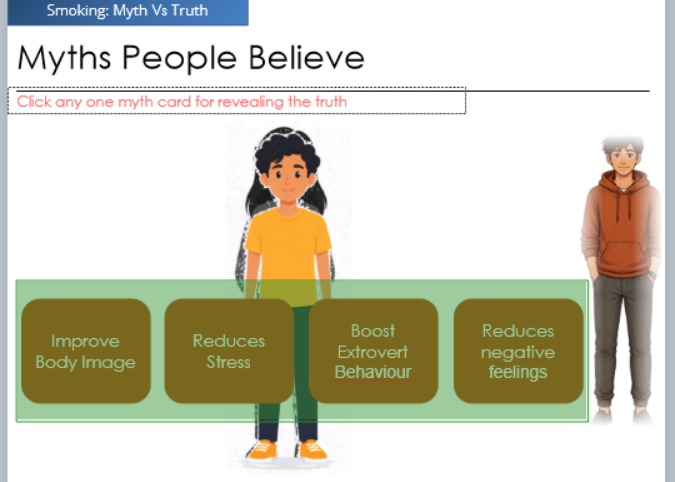
Smoking reduces stress
Nicotine temporarily relieves withdrawal symptoms it created — a cycle of dependency that increases baseline stress over time.
Smoking helps people socialize
Social connection comes from shared moments — not the cigarette itself. The same belonging can be found through non-smoking social rituals.
Smoking reduces negative feelings
Smoking masks emotions rather than resolving them — and long-term dependence is linked to increased anxiety and depression.
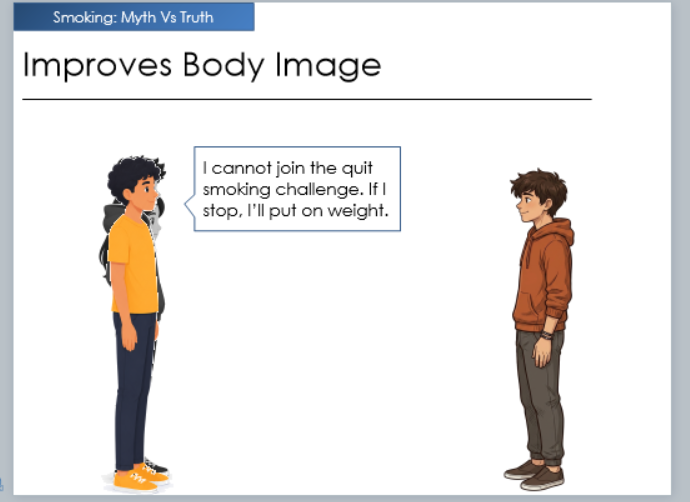
Smoking improves body image
The perceived weight-control appeal is heavily shaped by media framing — and ignores the visible physical effects of long-term use.
Design Process (ADDIE)
Learner & Needs Analysis
Identified the target audience as college students at risk of smoking initiation. Mapped the gap between fear-based programs and the actual psychological triggers, defining motivations across five categories: stress, social belonging, confidence, emotional regulation, and body image.
Content Architecture & Storyboarding
Structured the module around four myth-based arcs, each explored through dialogue between two student characters. Applied Bloom's Taxonomy to sequence learning from awareness through critical evaluation. Produced detailed storyboards before development.
Interactive Build in Storyline 360
Built the module using layer-based branching for conversation flows, trigger-driven variable logic for learner choices, and slide-level states for dynamic avatar selection. Audio narration produced with AI voice tools refined in Audacity; visuals designed in PowerPoint and Canva.
Assessment & Reflection Design
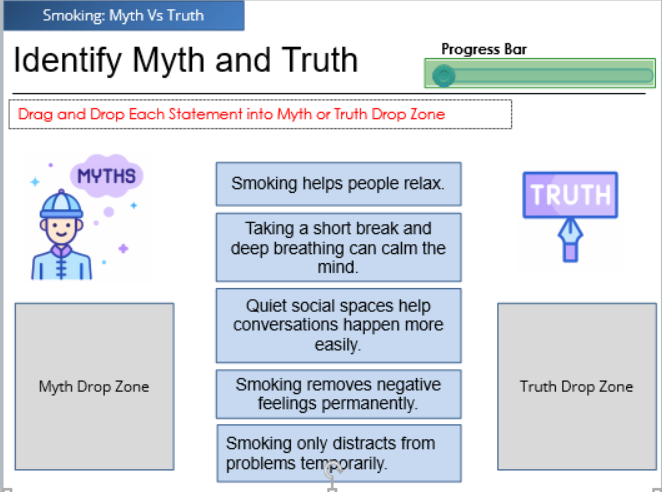
Replaced recall-heavy quizzes with scenario-based knowledge checks (drag-and-drop and situational MCQ) requiring applied understanding. Reflection prompts invite personal connection, and a completion certificate reinforces achievement.
Key Features
Continuous Story Narrative
A persistent storyline connects all four myth modules, building emotional continuity and preventing the "slide-flipping" feeling common in compliance-style e-learning.
Psychology-Led Dialogue
Character conversations model empathetic, non-judgmental enquiry — helping learners explore their own assumptions through the story rather than being lectured at.
Meaningful Branching
Learner choices influence how Siddhartha responds in each scenario, making the learner an active participant rather than a passive observer.
Dynamic Avatar Selection
Learners choose a character to represent them throughout the module, increasing identification with the story and deepening emotional investment.
Contextual Knowledge Checks
Interactive drag-and-drop and scenario-based assessments test applied understanding — not just memory — keeping learners engaged beyond passive reading.
Completion Certificate
A personalized certificate marks module completion, providing a tangible sense of achievement and reinforcing the value of the learning experience.
Tools & Technologies
Storyline 360
Core development platform for interactions, branching logic, and SCORM publishing.
PowerPoint
Character assets, background illustrations, and visual layout design.
Canva
Graphic elements, UI icons, and supplementary visual design assets.
Audacity & AI Voice
Audio narration recording, editing, and AI-assisted voice production.
Skills Demonstrated
This project demonstrates what happens when instructional design starts with the learner's psychology — not the subject matter.
By centering design decisions on the emotional and social realities of the target audience, the module transforms smoking awareness from a compliance exercise into a genuinely reflective experience. Learners engage not because they have to — but because the story feels true to their world. The result is a portfolio piece that showcases the full ADDIE process, applied behavioral theory, and production-level Storyline 360 development.
Storyboard: Myth vs. Truth
The storyboard served as the instructional blueprint for the entire module — translating learning objectives into screen-by-screen interactions before a single Storyline slide was built.
Storyboard Anatomy
Each storyboard slide follows a consistent four-column structure — ensuring every design decision is captured in the same place, in the same format, across all 12 screens.
On-Screen Text
All visible text content — headings, body copy, button labels, card text — exactly as it should appear to the learner in Storyline.
Visual Layout
A wireframe-level visual showing character placement, interactive elements, background treatment, and spatial composition.
Navigation Info
Trigger logic and interaction flow — what happens when a learner clicks, hovers, or completes an action, and where they go next.
Designer Notes
Technical and visual notes for development — animation behaviour, state changes, colour values, and Storyline-specific details.
Selected Storyboard Slides
How I Built the Storyboard
Started with learning objectives, not slides
Before opening PowerPoint, each myth module's objective was written using Bloom's Taxonomy action verbs. Every slide was reverse-engineered from what the learner needed to be able to do — not what content needed to be covered.
Mapped Gagné's events to story beats first
Gagné's nine events were plotted as a narrative arc before any layout was sketched — ensuring the storyboard was a sequenced instructional experience, with attention, recall, guided practice, and transfer all intentionally placed.
Wrote full narration scripts, not talking points
Audio text was written as complete, conversational sentences — not bullets. This forced tone decisions early, revealed preachy language before recording, and made voice production faster and more consistent.
Captured Storyline logic in designer notes
Every animation trigger, variable condition, and state change was specified in the designer-notes column. The development phase became largely execution — reducing back-and-forth and keeping the design intent intact.